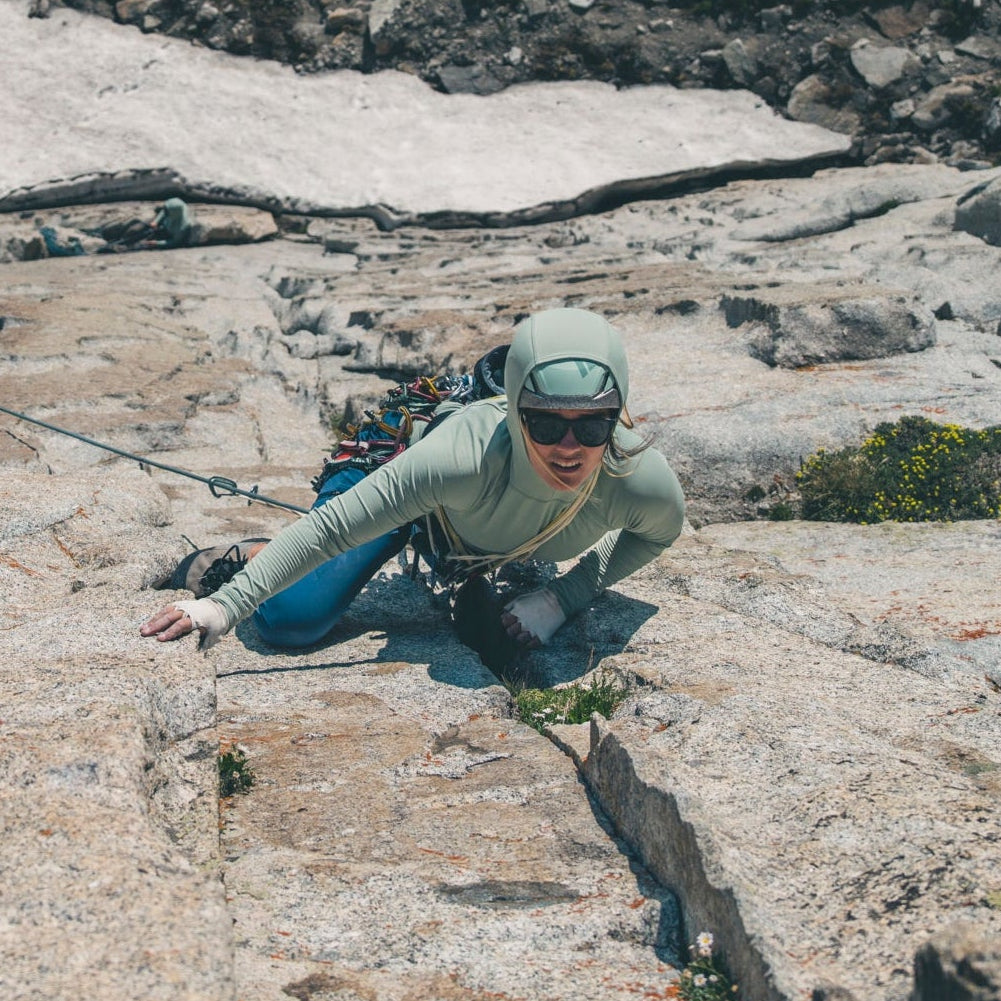
Long days, short nights, and high snowlines mean it’s alpine climbing season—whether you’re dreaming of Bugaboo Spire, Temple Mountain, or Cathedral Peak, make sure your fit, from head to toe, is dialed for alpine sending. 

AVERAGE ALPINE CONDITIONS

When thinking of an average day in the alpine, most climbers think of waking up hours before dawn, hiking to the cliff by headlamp under the stars, and racking at dawn. As they make their way up the wall, the rising sun warms the wall. The climbers enjoy a slight breeze, so they don’t get too hot as they top out on the summit. After the descent, they stop by an alpine lake for a quick dip and are back at the car by dusk.

Well, that’s a dream, a fantasy, some even say a myth, of alpine rock climbing. A normal day in the alpine usually consists of temperature swings that go from below freezing to damn near sweltering; maybe a sudden, unforecasted thunderstorm that drops rain, sleet, and snow; gusty winds that tangle ropes and freeze fingers.

There is rarely a ‘perfect’ day in the alpine, and the average day can be described in one word: variable.

ALPINE LAYERING SYSTEM

The clothing you bring for rock climbing up high needs to perform in a variety of conditions while remaining lightweight. The ideal alpine climbing kit should consist of intentional, technical pieces that are durable, serve multiple functions, and are packable. All while being comfortable to climb in. There is a high bar for a piece of clothing for alpine rock climbing, but the picks below have all been proven in the field.

Knowing you could face many different conditions in a day leads many people to bring too many layers on a day of alpine climbing, but in true alpine style, light is right. Only bringing exactly what you need is the goal to keep pack weights low and systems simple.

TOPS

When choosing a top-layering system for alpine climbing, two words should come to mind: variable and regulation. It’s about managing core body temperature through ever-changing weather. Doing this with minimal gear is a challenge, but by utilizing two or three intentional layering pieces, you’ll be linking pitches comfortably.  

The ultimate piece of clothing while in the alpine is the Alpenglow Sun Hoody. It adds UV protection, is breathable, stretchy, and comfortable to wear on its own. If it is a day in the alpine, it’s a day for an Alpenglow.  

If you prefer wearing a tee under a sun hoodie, make sure it is breathable and quick-drying. The Lightwire Tech Tee is lightweight and stretchy. For cooler days, the Lightwire Tech Long Sleeve Tee is an option, or on especially chilly days, the Coefficient LT Hybrid Hoody can be thrown over a t-shirt or worn as a baselayer.  

For blustery conditions on the wall or a sudden squall, the Alpine Start Hoody offers wind and weather protection. This shell is lightweight, packable, and easy to stuff into the bottom of your on-route pack. Or, if you plan on going sans pack, the Alpine Start Hoody is breathable and a good option for shady, north-facing routes, and it stuffs into the zippered chest pocket and clips to a harness.  

For the afternoon thunderstorms common in the Rocky Mountains, the Deploy 3L Shell is easy to keep in your bag and throw on when the storm hits. The Deploy 3L is an extremely packable, waterproof shell. It doesn’t need to be in your alpine pack for every outing, but it should be on the gear list.  

INSULATION

In an attempt to go lightweight, it can be easy to skip an insulating layer, but as this author can attest, it’s no fun shivering on a belay ledge 6 pitches up waiting for a storm to pass. A midlayer like the Deploy Down 0.5 Hoody or the First Light 1.0 Stretch Hoody is a good option to bring on route. The Deploy Down 0.5 Pullover Hoody is the lightest down hoody in the world, weighing only 148 grams. It’s a no-brainer for a packable insulating layer in the alpine. If you prefer a synthetic option that is still packable and breathable, the First Light 1.0 will be your pick. 

PANTS

While alpine climbing, the route can be as variable as the weather and having pants that can handle scraping along a chimney while still being comfortable on the hike in is key. Our Alpine Pants collection is purpose-built for alpine climbing (it’s in the name) and comes in three different styles: Alpine Light, Alpine, and Alpine Hybrid. All styles feature articulated knees, a durable synthetic construction, and harness-compatible pockets with zippers. The Alpine Light pants are lightweight and breathable, and a great option if you are climbing in hotter climates. The Alpine Hybrid Pants are best for routes with a lot of offwidth pitches, or a bushwhack approach, and the Alpine Pants are the Goldilocks option.

ACCESSORIES AND OTHER GEAR

An easy piece of apparel to overlook while alpine climbing is socks. Sure, they are more for the approach, but a good pair of socks paired with comfortable, well-fitting approach shoes prevents blisters on the long approach. Keep your feet happy before the climbing starts by investing in quality merino socks. Generally, a thin, lightweight sock, like the BD Light Crew Merino Socks, is a good option.  

A small, durable pack like the Blitz 20 Backpack stores your layers on route and is durable enough for hauling on pitches where you don’t want to wear a pack. Or if your system is super dialed and you're only bringing a single layer, the Puffy Stash has 5L worth of storage and sits comfortably above a harness. 

THE BOTTOM LINE

Alpine rock climbing is adventurous, and conditions are bound to be variable; it’s important to be prepared. If you think your puffy is too warm, ditch it and bring a fleece with a wind shell instead. Then you can just wear the fleece or just the shell, depending on conditions. Your pants need to be durable enough for pitch after pitch of climbing, but comfortable enough to wear for 12+ hour days.

In every aspect, alpine climbing is demanding on a climber—physically, mentally, andon their gear and apparel. Your alpine clothing system should be intentional and consist of apparel that is lightweight, packable, and durable.

Ready for your next alpine trip? Makre sure your gear is dialed with our What to Bring Alpine Rock Climbing article.

KEY TAKEAWAYS

Variable is the name of the game:  A "perfect" day in the alpine is the exception, not the rule. Plan for temperature swings, surprise storms, and wind. Then build your kit around variability rather than best-case scenarios. 

Light is right, but don't cut corners on insulation: Going ultralight is the goal, but skipping a midlayer is a mistake you’ll only make once. Picking a packable down or synthetic hoody earns its weight every time. 

Modular and multi-functional: Two or three intentional pieces that can be mixed, matched, and stuffed into a pack will outperform a bag full of single-purpose layers every time. 

Don’t forget about the approach: Keep your feet happy on the long approach in with quality socks and approach shoes. Make sure your climbing clothes are also comfortable for long-distance hiking. 

Molly climbs The Thumb on Lone Peak.

ABOUT THE AUTHOR

Molly Malone is Black Diamond Equipment’s copywriter. Her expertise in outdoor apparel and equipment comes from a decade-long love affair with backcountry splitboarding and climbing. She likes low-angle powder laps on high-avy days and sending long desert splitters.