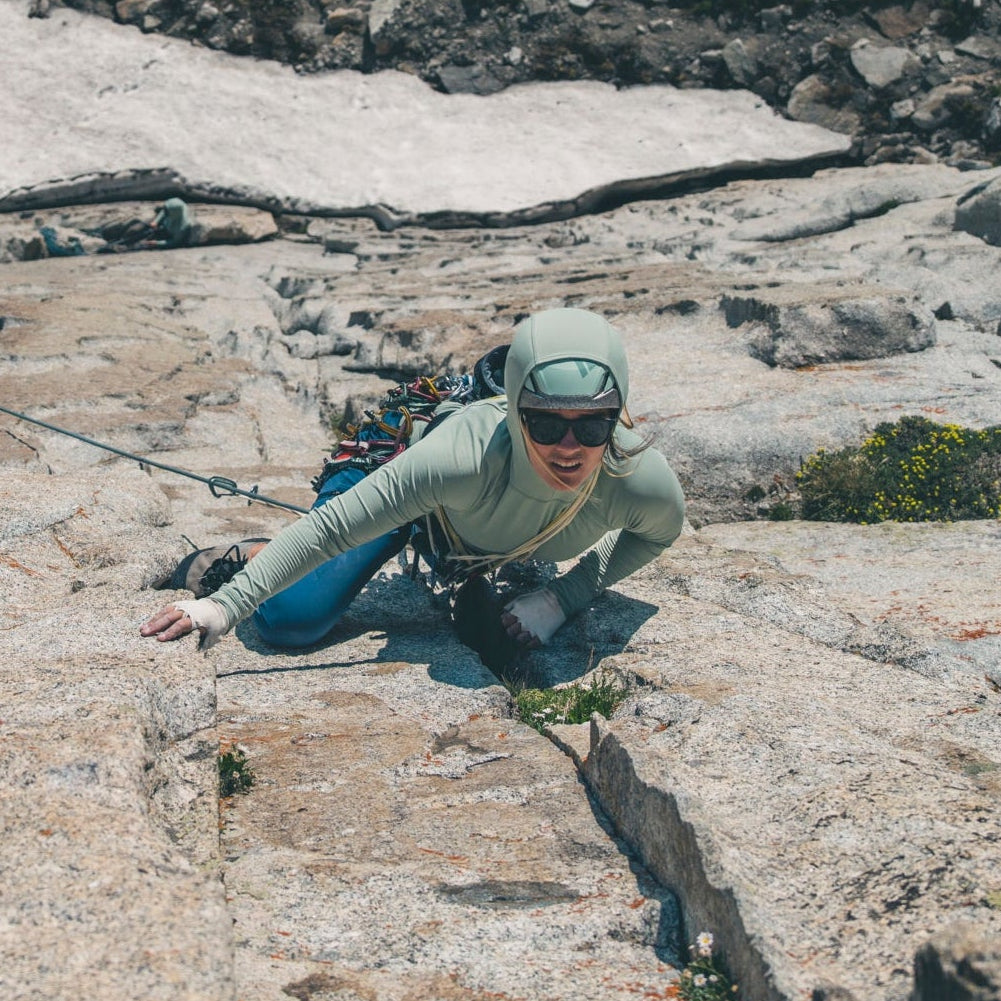
“I learned to trad climb on cams first; it wasn't until well after I'd gotten comfortable placing, cleaning, and weighting cams that I learned to place and clean a nut.”
—Connor Herson

In the spring of 1967, Liz and Royal Robbins climbed a new route in Yosemite, bringing only stoppers and slings as protection instead of the “traditional” pitons and hammer. Their ascent was the first multi-pitch climb in North America established with protection that left the rock unmarked and undamaged. They called the route the Nutcracker Suite, and by climbing the route in this style, Liz and Royal ushered in the era of clean climbing. Before the Nutcracker, protecting a climb was characterized by pounding pitons and swinging hammers, which left permanent marks in the rock. But by introducing stoppers and hexes and, eventually, cams, climbing became less destructive. Free climbing as we know it today started with a simple wire.
But now, nearly 60 years later, when climbers walk up to a crag, their rack is loaded up with C4s and Z4s—cams—while their stoppers (if they own any) collect dust in their gear closets.
A quick survey around the Black Diamond office revealed mixed stopper usage. Many of the younger trad climbers said they didn’t place stoppers at all; some didn’t own a single nut. Even the veteran trad climbers we interviewed who’ve been in the game a while aren’t placing stoppers on routes much nowadays. Some just bring them on alpine climbs, trying to go fast and light, or as a cheap bail option. Go to the forums of Reddit or Mountain Project, and you’ll see debaters and trolls arguing over the end of stoppers.
So, it begs the question: has a pivotal piece of gear—one that changed the trajectory of climbing—become a relic of the past?

“I learned to trad climb on cams first; it wasn't until well after I'd gotten comfortable placing, cleaning, and weighting cams that I learned to place and clean a nut.”
—Connor Herson
He started climbing in grade school, and now, at 22, Connor Herson has climbed the hardest trad route in the world, establishing himself as one of the best trad climbers, yet he says he rarely, if ever, places stoppers.
Connor is part of the new generation of trad climbers, ushering in the future of the discipline, and his first gear placements were cams. If young trad climbers aren’t reaching for stoppers, does it mean the era of stoppers may go the way of hexes and Tricams?
“These days, pretty much the only time I'll place a nut is if the placement is too thin for a cam, although these days Z4s go pretty small, so I almost never use them!”

“I often still bring a rack of nuts on a trad multi-pitch, but to be honest, I don’t use them that often anymore.”
—Babsi Zangerl
Next, we asked Babsi Zangerl, a veteran trad climber who has climbed notable big walls and multi-pitch routes all over the world. She has a more traditional (pun intended) opinion on stoppers compared to Connor. Babsi ZangerlNext, we asked Babsi Zangerl, a veteran trad climber who has climbed notable big walls and multi-pitch routes all over the world. She has a more traditional (pun intended) opinion on stoppers compared to Connor.
Babsi thinks stoppers are still important and brings them up climbs, but does mention she’s been reaching for them less over the years.
She also explains how stopper placements are more secure on small limestone cracks where the smallest cams tend to be insecure. There’s more limestone trad climbing in Europe than in North America; here in the States, there are great seas of granite and sandstone, and Babsi clarifies: she never uses nuts on granite.

“In the UK, there is less protection in general, and you need to cover all your bases and take a large rack of cams and stoppers.”
—Hazel Findlay
It seems we are finally getting somewhere in this debate; maybe nut usage is more of a geographical thing. Hazel Findlay is from the UK and has done some of the boldest ascents there, and she offers her expertise on UK trad climbing.
Hazel also mentioned that climbers approach protection differently in the UK. It’s all about protecting the integrity of the rock; that means no bolts on routes, so many times wires are the only option for marginal placements. As an added plus, the rock type in the UK is better suited to stoppers.
And this makes sense; the UK’s clean climbing ethic runs deeper and has a longer history compared to the States. Stoppers were first used in the UK back in the 1950’s and became commonplace—it was a trip to the UK that inspired Royal Robbins to use only stoppers to climb Nutcracker Suite.

“I choose cams over stoppers because they are faster to place, and they do the same job as stoppers in most situations.”
—Jacopo Larcher
The practicality of using cams over stoppers is a simple explanation for why climbers use them less. The climbing technology has just gotten better. Jacopo explains:
But Jacopo does argue that there are a few key advantages to stoppers over cams. He likes them in limestone cracks and on multi-pitch walls for anchors.
You would think there’s a lot of debate within the BD office among athletes and employees about the use of stoppers, but a consensus emerged: people bring stoppers on climbs, but they rarely get placed.
Stoppers aren’t dead…yet, but the next generation of trad climbers, like Connor Herson, is learning to lead with cams. It isn’t until they are well into their trad climbing careers that many of them are picking up a set of nuts to place on specific climbs. Which does make me wonder if you’ll see more stoppers stuck on multi-pitch routes, lost because the follower does not know how to clean them, similar to Tricams.
But it’s unlikely climbers will completely stop using nuts. While improved camming technology has made them less common, stoppers will undoubtedly continue to be used on specific climbs and in specific scenarios and geographic locations. The UK started using them first, and it is unlikely climbers there will stop, even as cam technology continues to improve.
Plus, there’s one key perk to stoppers in the long run, Jacopo adds:
So, trad climbers, dust off your nut tools and learn how to clean a stuck stopper—keep passive protection alive!